
What is iGaming affiliate marketing?
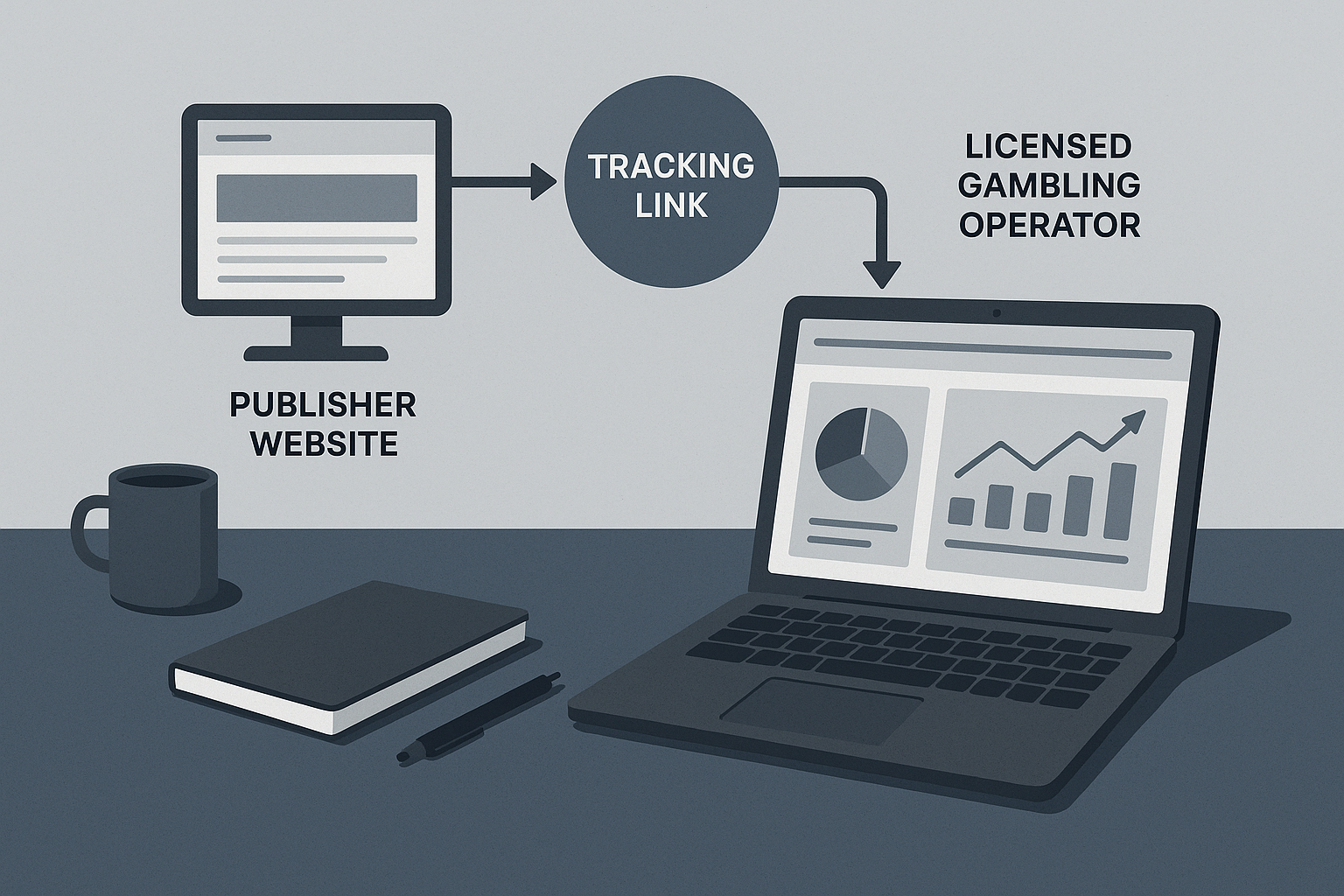
An iGaming affiliate is a publisher that sends traffic to licensed gambling operators and gets paid when that traffic turns into registered, depositing players. The affiliate owns the content and the audience. The operator owns the product, the licence and the player relationship. Money moves one way: performance-based commission from operator to publisher, paid only after a measurable action.
That is the whole model in one paragraph. Everything else, the commission negotiations, tracking pixels, editorial standards, state licences, is machinery built around it.
The three-party model
Three parties sit in the chain, and each one has a distinct interest:
- The operator (a licensed sportsbook or online casino) needs new depositing customers at a cost it can justify against expected player value.
- The affiliate (a review site, comparison site, news brand, YouTube channel or newsletter) owns attention and monetises it by referring users through trackable links.
- The player arrives with a question, which brand pays out fastest, which bonus is actually worth claiming, and clicks through to sign up.
The mechanics are ordinary affiliate marketing. A user clicks a tracked link, a cookie or server-to-server postback records the referral, and the operator attributes the sign-up to the affiliate’s ID. What differs is the qualifying event. In most other verticals the trigger is a sale. Here it is usually a first deposit above a minimum threshold, sometimes plus a wagering condition, which is why affiliates obsess over the definition of “qualifying player” in their contracts.
Role in the iGaming ecosystem
Affiliates function as the vertical’s search and comparison layer. In a US market where a single state can license a dozen sportsbooks and as many online casinos, players use third-party sites to compare bonuses, payment methods, game libraries and payout speeds. Operators tolerate paying for that traffic because the cost is variable rather than fixed: no player, no fee. Compared with a television campaign or a stadium sponsorship, affiliate spend is measurable to the dollar, which is exactly why finance teams like it and why acquisition budgets keep flowing into it.
How do iGaming affiliates make money: commission models
Affiliates are paid under three main structures, CPA, revenue share, and hybrids of the two. The choice determines cash flow, risk, and how much an affiliate cares about what happens to a player after the sign-up.
| Model | What triggers payment | Cash flow profile | Main risk to the affiliate |
|---|---|---|---|
| CPA (cost per acquisition) | One-off fee per qualifying depositing player | Fast, predictable, front-loaded | No upside if the player is highly valuable; caps and quality reviews |
| Revenue share | Percentage of the operator’s net revenue from referred players, paid monthly for the player’s lifetime | Slow to build, compounding | Player losses and negative carryover; definition of “net” revenue |
| Hybrid | Smaller upfront CPA plus a reduced revenue share | Balanced | Both sets of terms apply at once |
| CPL (cost per lead) | Registration or verified lead, no deposit required | Fast, low value per action | Tight quality thresholds; often capped or geo-limited |
CPA (cost per acquisition)
CPA pays a flat fee each time a referred user completes the qualifying action, typically a first deposit at or above a set minimum. In regulated US markets, CPA rates for sportsbook and casino sign-ups are commonly quoted in the hundreds of dollars per player, but the number is meaningless without the surrounding terms. Read the qualifying criteria, the monthly cap, the geo restrictions, and the clawback clause covering fraud, bonus abuse or duplicate accounts. Two deals with identical headline CPAs can pay out very differently.
CPA suits publishers who want clean, forecastable revenue and who don’t want their income tied to how referred players perform.
Revenue share model
Revenue share pays a percentage of the operator’s net gaming revenue generated by referred players, month after month, for as long as those players stay active. Percentages in the 25% to 40% band are commonly cited for standard deals, with better rates negotiated on volume.
The word doing the work is “net”. Operators typically deduct bonus costs, payment processing fees, gaming taxes and sometimes a flat administrative charge before calculating the share. Two other terms matter. First, negative carryover: if referred players win more than they lose in a month, that negative balance can be carried into the next month before the affiliate earns again. Second, the exclusion of certain low-margin products or bonus-heavy promotions from the revenue calculation. Long-term revenue share can outperform CPA substantially, but only for affiliates with enough capital to wait out the ramp.
Hybrid commission structures
Hybrids pair a reduced upfront CPA with a lower ongoing revenue share, so the publisher recovers some content and traffic acquisition cost immediately while keeping exposure to player value. Larger media brands often run different models per operator and per state, CPA where player value looks weak or a market is new, revenue share where an operator’s retention is strong. Some negotiate flat monthly placement or sponsorship fees for fixed positioning, which sits outside performance pay entirely and needs careful disclosure.
The role of SEO and content in iGaming affiliate success
Most affiliate revenue in this vertical comes from organic search, which makes iGaming SEO the core operating discipline rather than a support function. Paid search for gambling terms is restricted, expensive and often locked to operators themselves, so publishers compete for rankings on commercial queries and build direct audiences around them.
Content-driven traffic strategy
Keyword strategy usually splits into three tiers. High-intent commercial pages target brand reviews, bonus code queries and state-specific comparisons, “online casinos in Michigan”, for example. Informational content covers rules, odds, RTP, house edge, payment methods and withdrawal timelines, capturing readers earlier in their research. News and data content, odds movement, launch coverage, regulatory updates, builds recurring visits and links.
Conversion tracking ties it together. Affiliates monitor click-through rate on outbound links, click-to-registration and registration-to-deposit rates, usually per placement and per sub-ID, then compare that against operator-reported conversions. Discrepancies between the two datasets are one of the most common commercial disputes in the industry. If you’re building out this side of the operation, our guide to SEO and content strategy covers the fundamentals in more depth.
SEO challenges and opportunities
Gambling content is treated as a sensitive category by search engines, and quality expectations are correspondingly high. Google’s guidance on experience, expertise, authoritativeness and trust pushes publishers toward named authors with verifiable credentials, transparent testing methods, clear ownership information and dated updates. Google has also acted against site reputation abuse, the practice of renting subfolders on unrelated high-authority domains to rank gambling content, which removed a chunk of parasite competition and raised the value of genuine standalone brands.
The practical difficulty is that the same twenty commercial keywords are contested by well-funded competitors in every state. The realistic openings are narrower topics, faster news coverage, original testing data, and states or products where competition hasn’t consolidated yet.
Building media brand authority
Durable affiliates stop behaving like affiliate sites and start behaving like publishers: bylined writers, a stated review methodology, corrections policy, editorial independence from commercial deals, and a mix of traffic sources including newsletters, apps and social channels. That reduces dependence on a single algorithm update and gives operators a reason to negotiate on brand terms rather than raw volume.
Are iGaming affiliates regulated?
Yes, in several overlapping ways. Affiliates are subject to consumer protection law, to state gaming regulations that can require registration or licensing, to advertising standards, and to the contractual rules of every operator programme they join. Non-compliance can mean withheld commissions, terminated contracts, or regulatory action against the operator that then falls back on the affiliate.
Disclosure requirements
In the US, the Federal Trade Commission’s endorsement guidance requires clear and conspicuous disclosure of material connections, including affiliate commission arrangements. In practice that means a plain-language disclosure placed where readers will actually see it, not buried in a footer, and honest presentation of rankings, especially where paid placement influences order. Language matters too: several US regulators have pushed back on terms like “risk free” and “free bet” where the offer carries conditions.
Responsible gambling standards
Affiliate content should carry age restrictions (21+ in most US regulated markets, though some states differ), a problem gambling helpline reference such as 1-800-GAMBLER, and links to support resources. The American Gaming Association’s responsible marketing code sets out industry expectations including not marketing to under-age audiences or on college campuses, and operators generally extend those obligations to their affiliates by contract.
The framing rule is straightforward: explain how products, odds and bonuses work, and never present gambling as income or a solution to financial pressure. Every game carries a mathematical house edge, and content that implies otherwise is both non-compliant and wrong.
State-level compliance
The US is a state-by-state patchwork. Some jurisdictions require affiliates to register or hold a supplier-type licence before receiving revenue share from a licensed operator, New Jersey and Pennsylvania are the long-standing examples, with vendor registration or certification categories that can capture affiliate businesses. Others rely mainly on operator-side obligations. Requirements change as markets open, so affiliates typically maintain a compliance matrix by state and product, and geo-target content so promotions only appear where the operator is licensed. For background on the regulatory side, see our overview of iGaming regulation and compliance. None of this is legal advice; licensing questions belong with a gaming attorney in the relevant state.
How iGaming media brands operate
The larger iGaming media businesses look like conventional digital publishers with an affiliate revenue line, plus display advertising, sponsorship, data licensing and sometimes B2B products. Headcount usually splits across editorial, SEO, product, partnerships and compliance.
Content strategy and editorial approach
A typical content operation runs an evergreen library (game guides, payment explainers, rules and odds content), a maintained review set updated as bonuses and features change, and a news desk. Reviews sit on a documented methodology covering licensing, payout times, game selection, bonus terms and customer support, so ratings can be defended to readers and regulators alike. The tension in this business is permanent: commercial teams want the best-paying brands prominent, editorial credibility depends on rankings that reflect actual quality. The publishers that last are the ones that resolve it in favour of the reader.
Relationship with operators
Operators run affiliate programmes in-house or through third-party affiliate platforms, with affiliate managers handling deal terms, creative approval, reporting and payment. Affiliates negotiate rates, placements and sometimes exclusive bonus offers; operators impose brand guidelines, prohibited-terms lists and traffic quality rules, and audit for compliance breaches. Reporting flows both ways, operator dashboards for clicks, sign-ups and revenue, affiliate-side analytics for traffic quality, with reconciliation meetings when the numbers disagree.
It is a supplier relationship, not a partnership of equals. Operators can change commission terms, close programmes or shift markets, and a publisher with one dominant revenue partner carries real concentration risk. Diversification across operators, states and traffic sources is the standard defence.
FAQ
How does iGaming affiliate marketing work?
A publisher joins an operator’s affiliate programme, receives a unique tracking link, and publishes content that sends users to the operator. When a referred user registers and makes a qualifying deposit, the tracking system attributes it to the affiliate, and the operator pays commission under the agreed model.
How do iGaming affiliates make money?
Through CPA payments per qualifying depositor, revenue share on the net revenue those players generate, hybrids of the two, and occasionally flat fees or CPL deals. Some also earn from display advertising and sponsorships.
What is iGaming SEO?
Search optimisation applied to gambling content: targeting commercial and informational gambling queries, meeting the higher quality and trust expectations that apply to sensitive topics, and structuring sites so state-specific and brand-specific pages can rank.
Are iGaming affiliates regulated?
Yes. They face FTC disclosure obligations, advertising and responsible gambling standards, operator contract terms, and in some US states registration or licensing requirements before they can be paid by a licensed operator.
This article is educational and covers a business model, not an invitation to gamble. Gambling carries a built-in house edge and long-term losses are the expected outcome. If gambling is causing harm, support is available in the US through 1-800-GAMBLER.