Industry overview and market size
The iGaming industry is the business of delivering real-money gambling products over the internet: online casino games, poker, bingo, lottery and, in most modern usage, sports betting. It covers the consumer-facing brands players see and, behind them, a much larger B2B layer of game studios, platform vendors, payment specialists, testing labs and marketing partners.
One terminology point matters before anything else. In Europe, “iGaming” is usually an umbrella term for all online gambling. In the United States, regulators and analysts often use it more narrowly to mean online casino (slots, table games, live dealer), keeping online sports betting, or OSB, as a separate category with its own laws, licences and tax rates. This article uses the broad definition but flags where the US split changes the picture.
Market value and growth projections
Any number you read for “the iGaming market” depends heavily on what is being measured. The industry-standard metric is gross gaming revenue (GGR): total wagers minus winnings paid to players. It is not the same as handle, the total amount wagered, which can be ten to twenty times larger in sports betting because stakes recycle. Comparing a GGR figure with a handle figure is the most common error in coverage of this sector.
For the US, the cleanest source is the American Gaming Association, which publishes commercial gaming revenue by vertical and by state. Its data shows US commercial gaming revenue setting successive records through the 2020s, with online casino and online sports betting supplying the bulk of the growth while land-based revenue stayed comparatively flat. Online casino GGR in the handful of states that permit it has grown into the multibillion-dollar range annually, and online sports betting is larger again. Editor: attach the current AGA commercial gaming revenue tracker and its latest annual figures here.
Global estimates from commercial research firms vary widely because of differing scope, so treat single headline numbers with caution and always check whether lottery, social casino and unregulated markets are included.
Geographic distribution
Regulated online gambling is concentrated in Europe, where markets such as the UK, Italy, Sweden and Denmark have licensed online casino and betting for years. North America is the fastest-growing region since the Supreme Court struck down the federal sports betting ban in Murphy v. NCAA (2018), which returned the decision to individual states. Latin America, led by Brazil’s newly regulated market, and parts of Africa and Asia are the next expansion fronts. Several large Asian markets remain closed or grey, which is why operator revenue there is hard to measure reliably.
Key players in the iGaming ecosystem
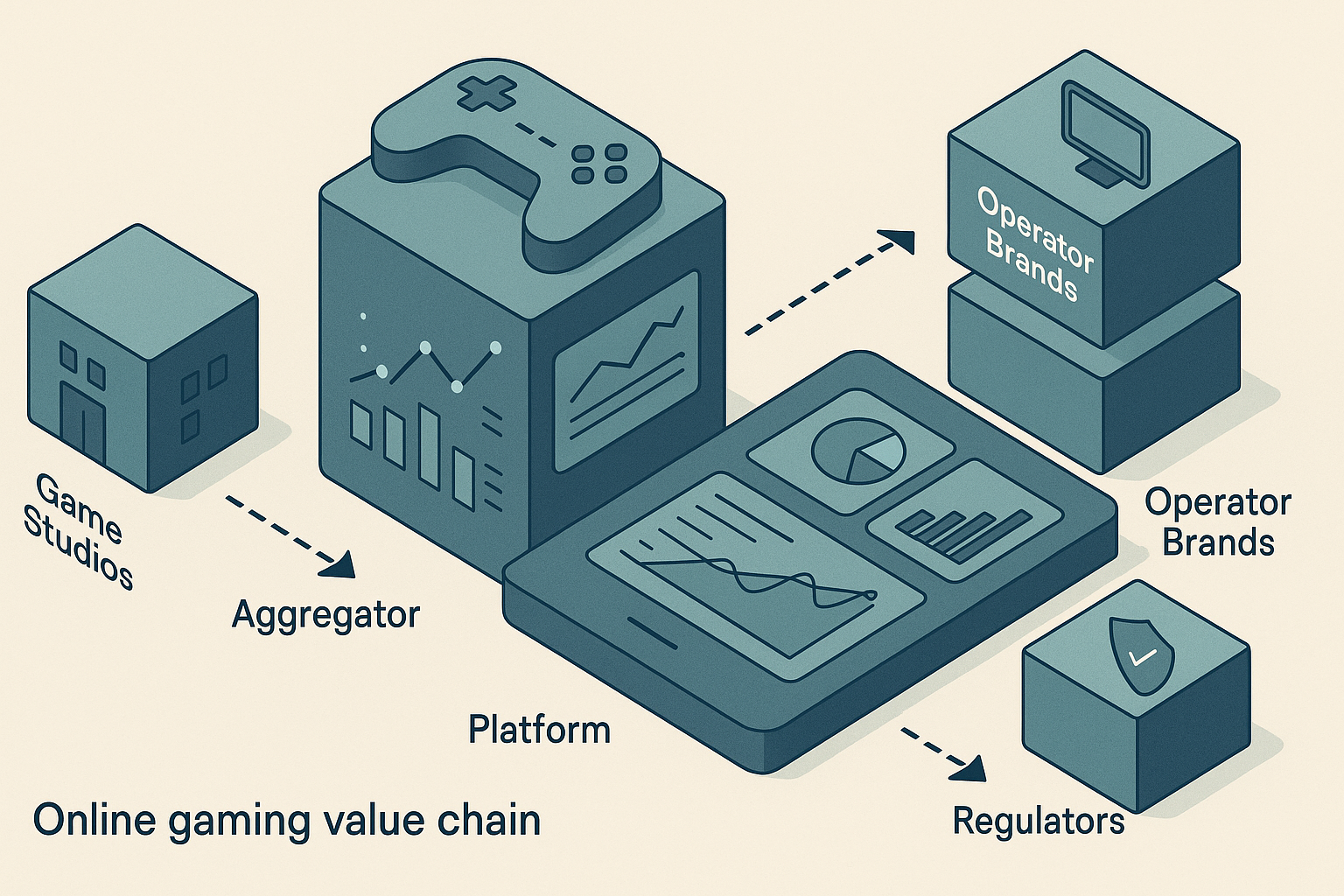
The iGaming business divides into five functional groups: operators who hold the customer relationship, game providers who make the content, platform providers who supply the technology, payment and compliance vendors, and affiliates who supply traffic. Money flows the other way, from the player’s stake back down the chain.
| Category | What it sells | Typical commercial model | Examples |
|---|---|---|---|
| Operator (B2C) | Licensed brand, wallet, customer relationship | Keeps GGR after fees, tax and marketing | FanDuel, DraftKings, BetMGM, Caesars |
| Game provider (B2B) | Slots, table games, live dealer studios | Share of the GGR its games generate | Evolution, Pragmatic Play, Light & Wonder, IGT |
| Aggregator (B2B) | Single integration to many studios’ games | Slice of content revenue share | Relax Gaming, Oryx, Pariplay |
| Platform / PAM (B2B) | Player account management, wallet, CRM, reporting | Monthly fee plus percentage of GGR | Playtech, Bragg, EveryMatrix, Kambi (sportsbook) |
| Affiliate / media | Player acquisition traffic | Revenue share, CPA or hybrid | Comparison and review networks |
Operators vs providers vs platforms
An operator holds the gambling licence, takes the bet, holds player funds and carries the regulatory liability. A provider makes the games the operator offers but never contracts with the player. A platform supplies the software that runs the operator’s account system, wallet, bonus engine and reporting. One company can be all three: Playtech develops games and licenses a platform, and Flutter both owns FanDuel and builds much of its own technology.
The B2B vs B2C distinction
B2C companies compete on brand, odds, promotions and retention, so they carry heavy marketing costs and direct regulatory exposure. B2B companies sell to those operators, earn revenue share rather than net gaming win, and are less exposed to any single market’s tax changes, though they still need supplier licences in most jurisdictions. Investors usually value the two groups on different multiples for exactly that reason.
What is an iGaming provider?
An iGaming provider is a B2B supplier of gambling content or the technology that delivers it. Providers build the games, certify the underlying random number generator (RNG) and game math with independent test labs, then license the content to operators, typically for a share of the gross gaming revenue those games produce.
Game development companies
Studios design the game itself: reels, features, hit frequency, volatility and the theoretical return to player (RTP). RTP is the long-run percentage of wagers a game returns on average; its inverse is the house edge, which is where operator margin comes from. Regulated US markets often require RTP settings to sit within a state-approved band and be disclosed to the regulator. Live dealer is a distinct sub-sector because it requires physical studios, dealers and broadcast infrastructure rather than software alone, which is why Evolution has been able to build a dominant position there.
Content aggregators
Aggregators solve an integration problem. Rather than an operator building a separate API connection to each of dozens of studios, an aggregator offers one integration that unlocks hundreds or thousands of titles, handling certification paperwork, game feeds and reporting. They take a cut of the content revenue share in exchange. For smaller studios, an aggregator is often the only realistic route to distribution.
Technology providers
Beyond games, operators buy specialist services: sportsbook trading and pricing engines, payment gateways, identity and KYC verification, geolocation (essential in the US, where wagering must be confirmed inside state lines), affiliate tracking software, and responsible gambling monitoring tools. Independent test labs such as GLI and BMM Testlabs sit alongside these vendors, certifying that games and systems meet each jurisdiction’s technical standards.
What is an iGaming platform?
An iGaming platform is the core software that runs a gambling site: player account management (PAM), the wallet, bonusing, KYC workflows, responsible gambling limits, regulatory reporting and back-office analytics. It is the operational spine that game content plugs into.
Platform-as-a-service model
Most platforms are sold as a service, hosted and maintained by the vendor, with pricing that mixes a monthly licence fee with a percentage of GGR. The commercial trade-off is straightforward: a platform vendor gets an operator live faster and absorbs compliance engineering work, while an in-house build costs more upfront but removes the revenue share and gives full control over the product roadmap. Larger operators tend to migrate in-house as they scale; DraftKings and Flutter both own significant proprietary technology.
White label vs turnkey solutions
These two models are frequently confused, and the difference is the licence.
- White label: the partner launches a brand under the platform provider’s gambling licence. Fast and cheap to start, but the licence holder controls compliance, payments and ultimately the player database.
- Turnkey: the operator obtains its own licence and payment processing, and leases the technology. Slower and more capital-intensive, with full ownership of the brand and player relationship.
White label is common in Europe. It is far rarer in the US, where state regulators generally require licensed operators, often tethered to a land-based casino, to hold the licence and take direct responsibility.
Supporting infrastructure: affiliates and media
Affiliate networks
Affiliates are performance marketers who publish comparison content, reviews and odds data, then send traffic to licensed operators for a commission. The standard models are revenue share (a percentage of the referred player’s net revenue, often for the lifetime of the account), CPA (a fixed fee per depositing customer), or a hybrid. In regulated US states, affiliates typically need their own vendor registration or supplier licence, and their marketing is bound by the same advertising rules as the operator: no targeting minors, no misleading claims about winnings, and mandatory responsible gambling messaging.
Industry media and events
The B2B layer is served by trade publications, data providers and conferences. Events like the Global Gaming Expo (G2E) in Las Vegas and ICE in Europe function as the industry’s main deal-making venues, where platform contracts, content distribution agreements and acquisitions are negotiated. State regulators publish monthly revenue reports that analysts and journalists use as the primary data source for market tracking, which makes public filings and regulator disclosures more reliable than vendor press releases.
Regulatory framework and licensing
Licensing is jurisdictional, not global. Every operator, and usually every supplier, needs approval in each market it serves, and compliance obligations cover anti-money laundering, KYC, game certification, advertising standards, data protection and player protection tooling.
US state-by-state approach
The US has no federal online gambling licence. Online sports betting is live in a large majority of states plus Washington, D.C., while legal online casino gaming remains limited to a much smaller group, including New Jersey, Pennsylvania, Michigan, West Virginia, Connecticut, Delaware and Rhode Island. Nevada permits online poker but not full online casino. Editor: verify the current state count against the AGA legal map before publication.
Each state has its own regulator, such as the New Jersey Division of Gaming Enforcement, the Pennsylvania Gaming Control Board and the Michigan Gaming Control Board, and its own tax rate on GGR. Those rates vary dramatically by state and vertical, and several states have raised them since launch, which has become a genuine risk factor in operator earnings models. Tribal gaming operates under a separate framework, the Indian Gaming Regulatory Act of 1988, overseen federally by the National Indian Gaming Commission and governed by state compacts. Federal statutes including the Wire Act and UIGEA still shape interstate transmission and payment processing.
International licensing bodies
For companies operating outside the US, a few regulators dominate corporate structuring decisions.
| Licensing body | Jurisdiction | Notes |
|---|---|---|
| UK Gambling Commission | United Kingdom | Strict player protection, affordability and advertising rules |
| Malta Gaming Authority | Malta / EU | Widely used corporate base for European-facing operators and suppliers |
| Gibraltar Gambling Commissioner | Gibraltar | Long-established, historically favoured by UK-facing groups |
| Isle of Man Gambling Supervision Commission | Isle of Man | Common for B2B platform and payment licensing |
| Curaçao Gaming Authority | Curaçao | Reformed licensing regime replacing the older master-licence system |
Player-facing compliance is part of the licence, not an optional extra: deposit and loss limits, session reminders, self-exclusion and cool-off tools are mandatory in regulated markets. Anyone gambling should treat it as paid entertainment with a built-in house edge, use those limits, and seek support if it stops being recreational.
Current market trends and future outlook
Technology innovations
Mobile now accounts for the large majority of online gambling activity, which has pushed product development toward app-first design, faster in-play betting and single-account cross-vertical wallets. Live dealer continues to take share of online casino revenue because it converts land-based table players. In-play and same-game parlay betting has changed sportsbook economics by raising hold percentages relative to traditional pre-match single bets. Crypto-native mechanics such as crash games and provably fair verification have grown in offshore markets but have almost no footprint in licensed US operations, where payments must run through regulated banking rails.
Market consolidation
The sector has been consolidating for a decade, on both sides of the value chain. Evolution’s acquisition of NetEnt in 2020 and Aristocrat’s purchase of NeoGames in 2024 are examples of suppliers buying scale in content and platform capability, while operators have bought their way into new states and technologies. The logic is consistent: compliance costs, multi-jurisdiction licensing and content distribution all reward scale, which squeezes mid-sized independents.
Emerging opportunities
The clearest growth levers are new jurisdictions, principally additional US online casino states and Brazil’s regulated market, plus rising tax and compliance sophistication in existing ones. Watch three things if you are tracking this sector: state-level online casino legislation, tax rate changes on existing licences, and the migration of large operators from third-party platforms to in-house technology. Each shifts revenue between the B2B and B2C halves of the industry.
FAQ
How big is the iGaming industry?
US commercial gaming revenue reached record levels through the 2020s, with online casino and online sports betting driving nearly all of the growth, according to American Gaming Association data. Global estimates differ widely depending on whether they measure GGR or total wagering and whether unregulated markets are included.
Who are the main players in iGaming?
Operators such as FanDuel, DraftKings, BetMGM and Caesars on the B2C side; suppliers such as Evolution, Pragmatic Play, Light & Wonder, IGT and Playtech on the B2B side; plus platform vendors, aggregators, payment and compliance specialists, and affiliates.
What is the difference between a provider and a platform?
A provider supplies the games or a specific technology service. A platform supplies the core account, wallet and back-office system the operator runs its business on. Some companies, Playtech among them, do both.