What does iGaming mean?
iGaming means real-money gambling and gaming conducted over the internet: online casino games, sports betting, poker, digital lottery and similar products delivered through a website or app instead of a physical venue. If money is wagered on an outcome and the whole transaction happens online, it falls under iGaming.
The “i” is simply shorthand for internet, following the same naming habit that gave us e-commerce and internet banking. The term took hold among European operators and suppliers in the 2000s, when the business of running online casinos and sportsbooks needed a label that wasn’t just “online gambling,” and it travelled to the US as the industry professionalised here.
What separates iGaming from traditional gambling isn’t the games. It’s the delivery. A blackjack table in Atlantic City and a blackjack table in a licensed New Jersey online casino follow similar rules, but the online version runs on software: a random number generator (RNG) decides card order or slot outcomes, geolocation software confirms you’re physically inside a state where the product is legal, and identity checks (KYC) happen before you can withdraw. The house edge is still there in both cases, and it’s still what makes the business work.
iGaming vs online casino vs sports betting: clearing up the confusion
Yes, iGaming is gambling. It’s an umbrella term, not a softer synonym. If someone asks “is iGaming gambling?”, the honest answer is that iGaming is the industry’s own word for online gambling, and online casino games and sports betting sit underneath it as categories.
Here’s where US readers get tripped up. In American industry usage, “iGaming” is often narrowed to mean online casino specifically, as opposed to online sports betting (frequently abbreviated OSB). So a headline that says “New York has sports betting but not iGaming” isn’t contradicting itself. It means the state allows online sportsbooks but not online slots and table games. Analysts, regulators and operators use the word this way constantly.
Three layers are worth keeping straight:
- Gambling is the broadest concept, online or off, including land-based casinos, retail sportsbooks and lottery counters.
- iGaming is the online slice of that, plus the businesses, suppliers and regulators around it.
- Online casino, online sports betting, online poker, iLottery are the specific product verticals inside iGaming.
One more distinction: “gaming” on its own usually means video games, and social casino apps that use virtual coins with no cash-out aren’t iGaming either, because nothing of monetary value is won. Real money in, real money out is the dividing line.
Main types of iGaming products
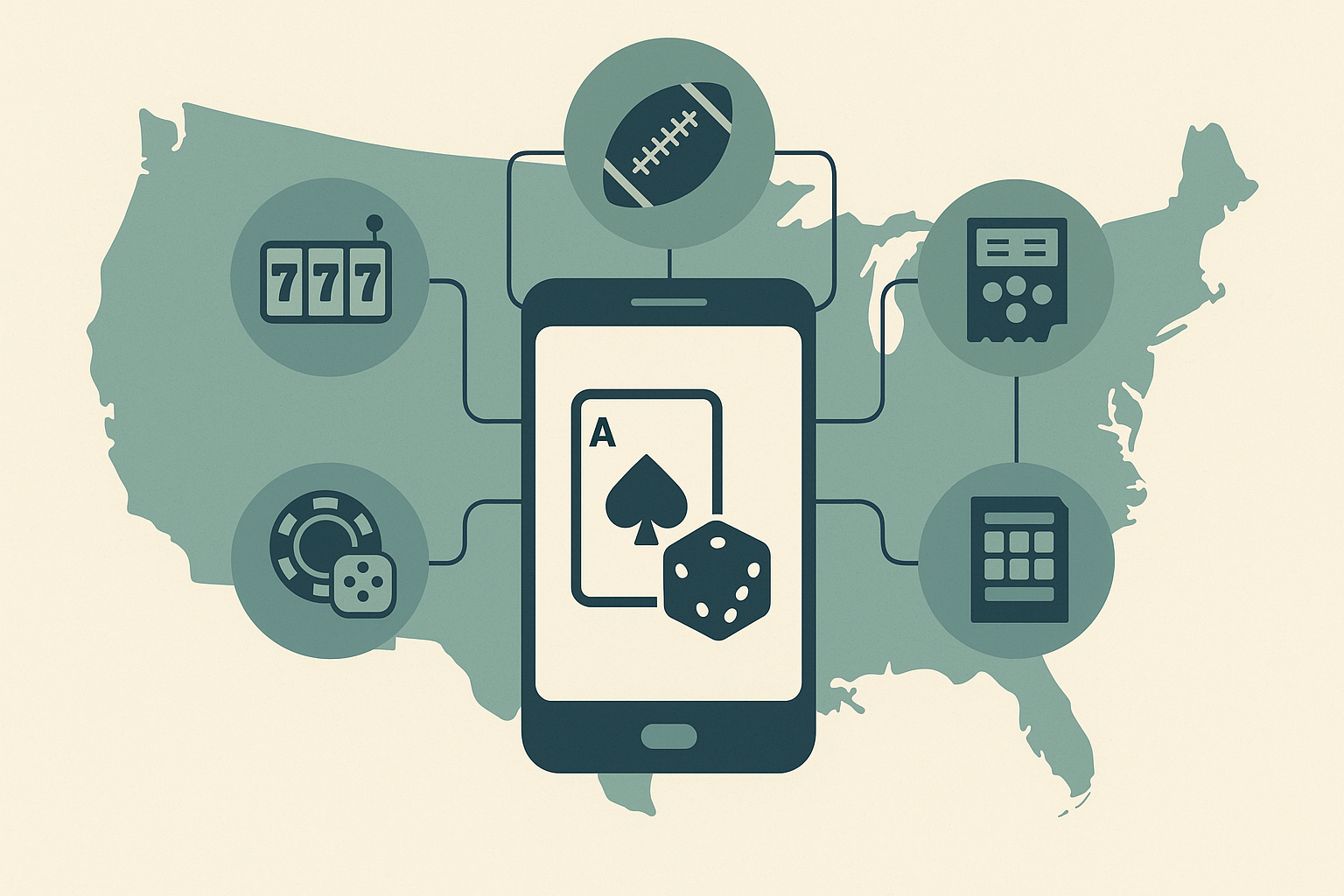
Most of the industry breaks into four product families. Legal status for each varies by state, which is why the same operator can offer sports betting in one state and nothing at all in the next.
Online casinos (slots, table games)
Slots, blackjack, roulette, baccarat, video poker and live dealer tables streamed from a studio with a real human dealing. Outcomes on digital games come from an RNG, and each round is independent, so there’s no such thing as a machine being “due.” Slots publish an RTP (return to player), typically somewhere around 94% to 97%, which is the long-run average return across millions of spins, not a promise about your session. The flip side of a 96% RTP is a 4% house edge. Volatility describes how bumpy the ride is, high volatility meaning rarer but bigger wins, and it doesn’t change the RTP.
Sports betting and daily fantasy
Online sportsbooks take wagers on games and events using odds that carry a built-in margin, sometimes called the overround. American odds (−110, +250) are the usual format here; converting to decimal odds makes the implied probability easier to see, since 1 divided by the decimal price gives the chance the price reflects. Daily fantasy sports (DFS) is a related but legally separate product in which entrants build lineups and are paid based on player statistics, and it has historically been regulated differently from sportsbook betting in many states.
Online poker and tournaments
Poker is player-versus-player, so the operator makes money from rake (a cut of pots) or tournament fees rather than a house edge on each hand. Liquidity matters enormously: a poker site needs enough players online to fill tables, which is why some states have entered shared-liquidity agreements to pool player pools across borders.
Digital lottery and instant games
Several state lotteries now sell draw tickets online and offer instant-win e-scratch games, usually referred to as iLottery. These are run by or on behalf of the state lottery itself rather than a commercial casino operator, and they often have their own age and account rules.
| Product type | What it covers | How the operator earns |
|---|---|---|
| Online casino | Slots, table games, live dealer | House edge (100% − RTP) |
| Sports betting | Pre-match and in-play wagers | Margin built into the odds |
| Online poker | Cash games, tournaments | Rake and entry fees |
| Daily fantasy | Statistical lineup contests | Entry fee commission |
| iLottery | Draw tickets, e-instants | State lottery prize structure |
How iGaming works in the US market
There is no single national online gambling market in the United States. Regulation happens state by state, and each legal state licenses operators, approves games, sets tax rates and runs its own enforcement. That’s the single biggest difference between the US iGaming industry and markets like the UK, where one national regulator covers the whole country.
The 2018 Supreme Court decision in Murphy v. NCAA struck down the federal law that had effectively blocked most states from authorising sports betting, and states moved quickly after that. Legal sports betting, retail or online, now operates in more than 30 states plus the District of Columbia. Online casino gaming has spread far more slowly: it is live in only a short list of states, including New Jersey, Pennsylvania, Michigan, West Virginia, Connecticut, Delaware and Rhode Island. Because legislatures revisit this every session, always check the current status with your own state’s gaming regulator or lottery commission before assuming anything.
A few mechanics that follow from state-level licensing:
- Geolocation. Licensed apps verify your physical location every session. Being a resident isn’t enough, you generally have to be inside state lines to place a wager.
- Licensed operators only. Legal sites hold a licence from a body such as the New Jersey Division of Gaming Enforcement, the Pennsylvania Gaming Control Board or the Michigan Gaming Control Board. Offshore sites that accept US players without a state licence sit outside that consumer-protection framework, and disputes are effectively unresolvable.
- Age limits. Casino and sportsbook accounts are typically restricted to 21 and over, though some products like lottery and DFS have different minimums depending on the state.
- Identity verification. KYC checks on name, address, date of birth and often the last four digits of your Social Security number are standard before withdrawals clear.
- Tax on winnings. Gambling winnings are taxable income federally and often at state level. Treat that as general information, not tax advice.
If you’re checking what’s permitted where you live, our state-by-state coverage in the US gambling guides is the place to start.
iGaming in business and media context
Outside of playing, the word mostly appears as a business label. Some concrete iGaming examples of how it gets used professionally:
- Job titles and departments. “VP of iGaming,” “iGaming compliance manager,” “iGaming affiliate manager,” “head of iGaming content.” Roles cluster around product, CRM and retention, payments, compliance, data analytics, game development and affiliate marketing, and plenty of them have nothing to do with taking bets.
- Company categories. The industry splits into B2C operators (the consumer-facing casino and sportsbook brands), B2B suppliers (game studios, live dealer studios, platform and payments providers), and affiliates or media companies that generate traffic.
- Conferences and trade press. Events like the Global Gaming Expo (G2E) in Las Vegas and ICE in Europe are where operators and suppliers meet, and trade outlets cover licensing decisions, quarterly revenue and market launches rather than individual games.
- Investment and policy coverage. Analysts talk about iGaming revenue as a reported line item, since regulators in legal states publish monthly gross gaming revenue figures. Legislative debates use the term to distinguish an online casino bill from a sports betting bill.
The American Gaming Association publishes industry-level research and state tracking if you want primary sources for the business side.
Frequently asked questions
What does iGaming mean?
iGaming means real-money gambling delivered over the internet, covering online casino games, sports betting, poker and digital lottery. The “i” stands for internet.
Is iGaming gambling?
Yes. It’s the industry’s term for online gambling. In US usage it often refers specifically to online casino games, with online sports betting treated as a separate category.
What are iGaming examples?
Playing licensed online slots or live dealer blackjack, placing a wager in a state-regulated sportsbook app, entering a daily fantasy contest, joining an online poker tournament, or buying a lottery ticket through a state iLottery site.
Is iGaming legal everywhere in the US?
No. Legality is decided state by state. Online sports betting is available in most states, while online casino gaming is limited to a handful. Check your state regulator for the current position.
A note on playing responsibly
Every iGaming product is built with a mathematical edge for the operator, which is why it should be treated as paid entertainment and never as a way to make money or fix a financial problem. Licensed sites are required to offer deposit limits, loss limits, session reminders, cool-off periods and self-exclusion, and it’s worth setting those before your first deposit rather than after a bad run. If gambling stops feeling like a choice, help in the US is available 24/7 through the National Council on Problem Gambling at ncpgambling.org or by calling or texting 1-800-GAMBLER. You can also read our responsible gambling guide for the tools worth using. Must be 21+ in most states.